 EA4FSI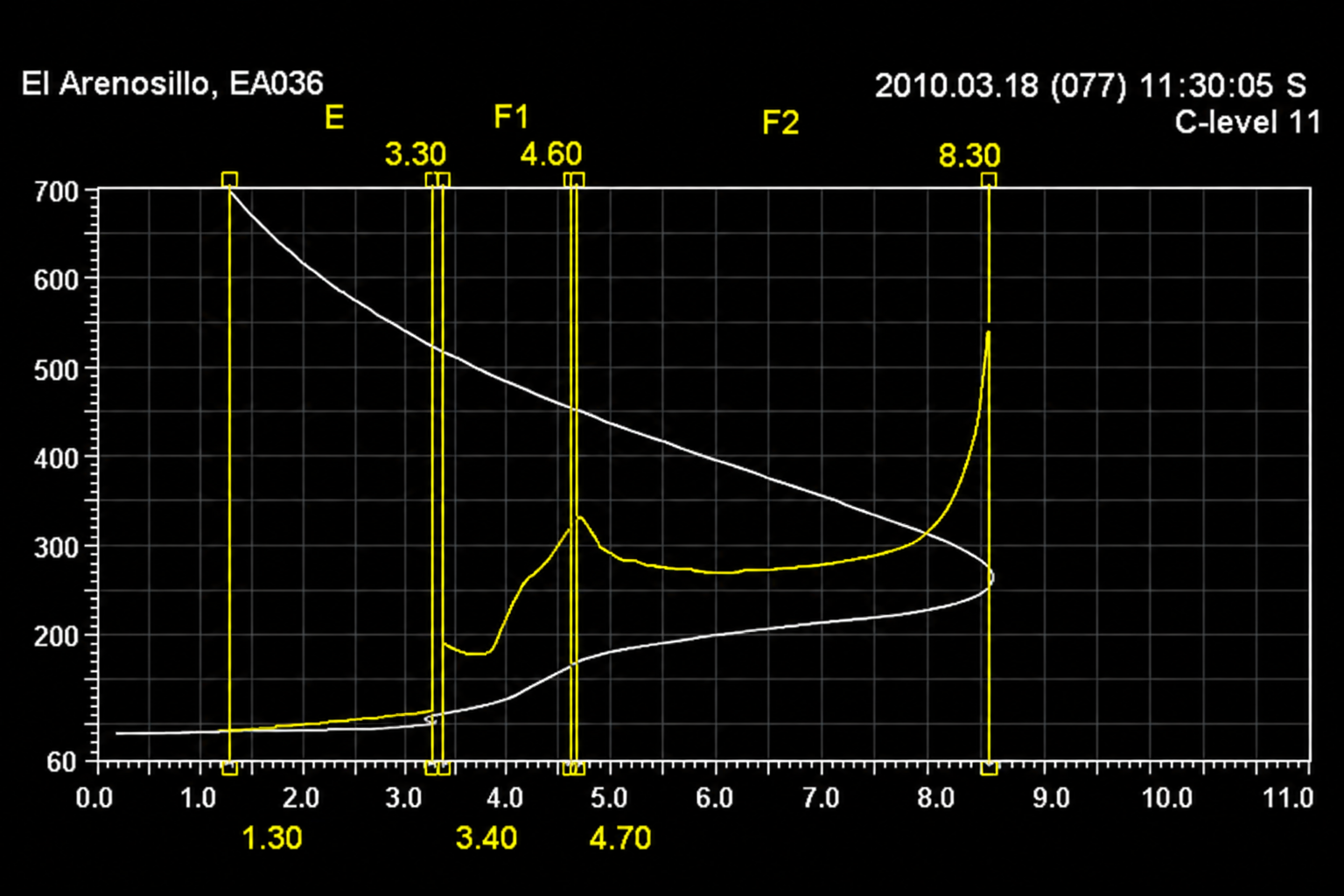
This article provides a didactic description, using scientific data, of the daily evolution of the different layers of the ionosphere, knowledge of which is essential for the proper operation of HF radio communication systems.
In order to achieve this, I have conducted an analysis of the parameters measured by the ionospheric sounding station that the INTA (Spanish National Institute of Aerospace Technology) uses in El Arenosillo (Huelva, Spain), on March 18, 2010. The ionosonde measures several parameters every 15 minutes, throughout the 24-hour day, using vertical sounding techniques in this particular case, that is, with an elevation angle of 90 degrees (perpendicular to the Earth's surface).
Those measurements provide a great deal of information about the ionosphere, such as the existence of the different layers at particular hours, their altitude, their thickness or their critical frequency.
Each layer of the ionosphere has its particular critical frequency (fo), defined as the maximum operating frequency at which the reflection of a radio wave in this layer, using a takeoff angle of 90 degrees. Thus, the sporadic layer Es has a critical frequency known as foEs, and the F2 layer will have its own, known as foF2. Knowledge of the foF2 frequency is of particular importance to work NVIS (Near Vertical Incident Skywave), a mode commonly used in tactical and emergency communications, due to the fact that at any given time, it determines the maximum frequency we can use.
All the data recorded by the ionosonde are stored in a SAO file and can be viewed using the SAO Explorer tool, developed by the University of Massachusetts Lowell Center for Atmospheric Research. For the particular case of the day under study, I have created a video showing what is happening in the ionosphere, every 15 minutes, during the 24 hours of the day.
1. Interpretation of the information
In the coordinate system used, frequency (MHz) is represented on the horizontal axis, and altitude over the Earth's surface (meters) is represented on the vertical axis. In the upper-right corner, in white letters, the date and time of each measurement are shown. The video shows the measurements taken every 15 minutes. In the upper part, in yellow letters, the tool shows the profile of each ionospheric layer of the ionosphere (E, F1, F2) at each hour, and also its critical frequency (foE, foF1, foF2) in MHz. In HF radio communications, reflection from the F2 layer is the most commonly used mode, so the evolution of the foF2 values will be interesting to follow.
In the lower part of the screen, in yellow letters, an indication appears whenever the sporadic layer Es is registered, showing also its critical frequency foEs.
In the central part of the screen, the white curve shows the results of the measurements related to the F2 layer. The point where this curve intersects the perpendicular line marking the foF2 frequency allows to determine, using the ordinate axis on the left, the altitude at which reflection from this layer occurs.
To make easier the interpretation of the data, other parameters measured by the ionosonde are omitted, referring to them in the chronological analysis only if they can provide information of interest.
2. Chronological analysis
The following section presents a chronological analysis of all the events observed. All the hours are expressed in GMT. In the day under study (2010/03/18), the hour in Spain, where the ionosonde is located, was GMT+1 (GMT in the Canary Islands), the sunspot number was SSN=24 and the solar flux index SFI=84. There were no events related to either solar or geomagnetic storms.
It is recommended that you pause the video at each key hour, so that each event can be examined in detail.
00:00 During the night, only the F layer is registered, referred to here as F2, located at an altitude of 292 km. The critical frequency foF2 reached only 3.100 MHz. Until 06:30 in the morning, only the 160-meter band can be used for NVIS operations.
02:15 1st occurrence of the Es sporadic layer, located at an altitude of 122 km, with a critical frequency foEs of 1.900 MHz. It will last until 02:45 and foEs will change to 2.300 MHz during this period.
04:15 2nd occurrence of the Es sporadic layer, located at an altitude of 90 km, with a critical frequency foEs of 2.000 MHz. It will last 15 minutes.
04:55 Dawn breaks, and the Sun begins to appear on the horizon.
05:00 3rd occurrence of the Es sporadic layer, located at an altitude of 120 km, with a critical frequency foEs of 2.000 MHz. It will last 20 minutes.
06:00 The critical frequency foF2 reaches its daily minimum of 2.500 MHz. Electron recombination in the ionosphere reaches its maximum level at this point of the night. From this moment, the presence of the Sun in the east will become increasingly noticeable and the foF2 will start to rise. Until this hour, the altitude of the F layer has oscillated between 250 km and 317 km.
06:45 Creation of the E layer at an altitude of 108 km, with a critical frequency foE of 1.420 MHz. The critical frequency of the F2 layer, foF2, has risen to 4.425 MHz, so the 80-meter band becomes usable for NVIS operations. This working window will last until 20:00.
07:30 4th occurrence of the Es sporadic layer, located at an altitude of 117 km, with a critical frequency foEs of 2.100 MHz. It will last 15 minutes.
08:15 5th occurrence of the Es sporadic layer, located at an altitude of 132 km, with a critical frequency foEs of 3.200 MHz. It will last 45 minutes and foEs will range from 1.900 MHz to 5.200 MHz during this period.
08:30 The effects of the rising Sun are now clearly visible and photoionization begins. The F2 layer critical frequency, foF2, now reaches 5.900 MHz.
09:00 The F layer, uniform until now, starts to be split into two sublayers: F1 at an altitude of 187 km and F2 at an altitude of 242 km.
09:30 6th occurrence of the Es sporadic layer, located at an altitude of 124 km, with a critical frequency foEs of 3.800 MHz. It will last 30 minutes.
10:15 7th occurrence of the Es sporadic layer, located at an altitude of 110 km, with a critical frequency foEs of 2.900 MHz. It will last 45 minutes.
10:45 The F2 sublayer is suddenly located at an altitude of 307 km. Its critical frequency, foF2, has risen to 7.050 MHz. The F1 sublayer is much lower, at an altitude of 177 km.
11:00 The F2 layer critical frequency, foF2, has reached 7.400 MHz, making the 40-meter band usable for NVIS operations. This working window will last until 18:45 in the evening.
11:15 8th occurrence of the Es sporadic layer, located at an altitude of 110 km, with a critical frequency foEs of 3.200 MHz. It will last 15 minutes. Now, the F1 and F2 sublayers have merged again into only one F layer, placed at an altitude of 222 km. A quarter of an hour later, they will separate again.
11:45 The Sun reaches its highest elevation, photoionization is at its maximum and now the F2 layer critical frequency, foF2, reaches also its maximum at 8.625 MHz. The ionosonde also registers the 9th occurrence of the Es sporadic layer, located at an altitude of 107 km, with a critical frequency foEs of 3.200 MHz. It will last 2 hours and foEs will range from 3.200 MHz to 6.300 MHz during this period.
12:30 The F1 and F2 sublayers merge again into only one F2 layer, at an altitude of 237 km, with its foF2 critical frequency reaching 8.000 MHz.
13:00 A sounding problem occurs and the ionosonde does not provide data during 15 minutes. Similar measurement failures occur at 14:00, 15:15 and 20:15 hours.
13:15 The F layer is split again into the sublayers F1 and F2. The ionosonde also registers the 10th occurrence of the Es sporadic layer, located at an altitude of 100 km, with a critical frequency foEs of 4.000 MHz. It will last 2 hours and a quarter, and foEs will reach 6.300 MHz.
14:45 The F1 and F2 sublayers are merged again, during 15 minutes, into only one F layer at an altitude of 242 km. Minutes later they separate again.
15:45 The F1 and F2 sublayers are merged again, during 30 minutes, into only one F layer at an altitude of 222 km. Minutes later they will split again.
16:45 11th occurrence of the Es sporadic layer, located at an altitude of 135 km, with a critical frequency foEs of 3.800 MHz. It will last 1 hour and 15 minutes.
18:30 As evening falls, the photoionization is weaker and the recombination of free electrons in the ionosphere starts. The electron density in the E layer is so low that the ionosonde is no longer able to detect this layer, although it will not disappear completely. The F1 sublayer will not be detected again until the next day, and the critical frequency of the F2 layer, foF2, will start to fall abruptly, although its current value is still 7.600 MHz.
18:45 The F2 layer critical frequency, foF2, has fallen down to about 7.000 MHz, making the 40-meter band unusable for NVIS from this moment.
19:15 Although the grade of ionization of the E layer is very weak, the ionosonde registers the 12th occurrence of the Es sporadic layer, located at an altitude of 120 km, with a critical frequency foEs of 2.700 MHz. It will last 45 minutes.
20:00 The F2 layer critical frequency, foF2, continues falling, reaching now 4.400 MHz. The 80-meter band will be unusable for NVIS operations in the next 15 minutes, until the next day.
20:15 The dusk arrives, the Sun begins to disappear below the horizon.
20:45 13th occurrence of the Es sporadic layer, located at an altitude of 120 km, with a critical frequency foEs of 2.600 MHz. This sporadic layer will last until midnight, and foEs will range from 1.900 MHz to 2.900 MHz during this period
22:45 The F2 layer critical frequency, foF2, continues dropping, reaching now 3.400 MHz.
23:45 As midnight approaches and the effects of electron recombination are now quite pronounced, to the point that foF2 has fallen to 2.700 MHz. A new day begins.